ProofJudgeDecision receipt
VerdictAccepted
Release payment
- Case
- OAuth callback hardening
- Score
- 92 / 100
- Artifact hash
- e692ee02…647c7d8a
- Signature
- HMAC-SHA256 · effa91fd…
- Judge identity
- 0xd36476…e5aC0
AI agents are starting to decide whether work is good enough to be paid. Who verifies the judge?

The threshold
When software agents produce paid work, a score is not enough. Payers, workers, evaluators, and downstream systems need a shared record of the terms, the decision, the judge identity, and whether the record changed afterward.
Touch the trust boundary
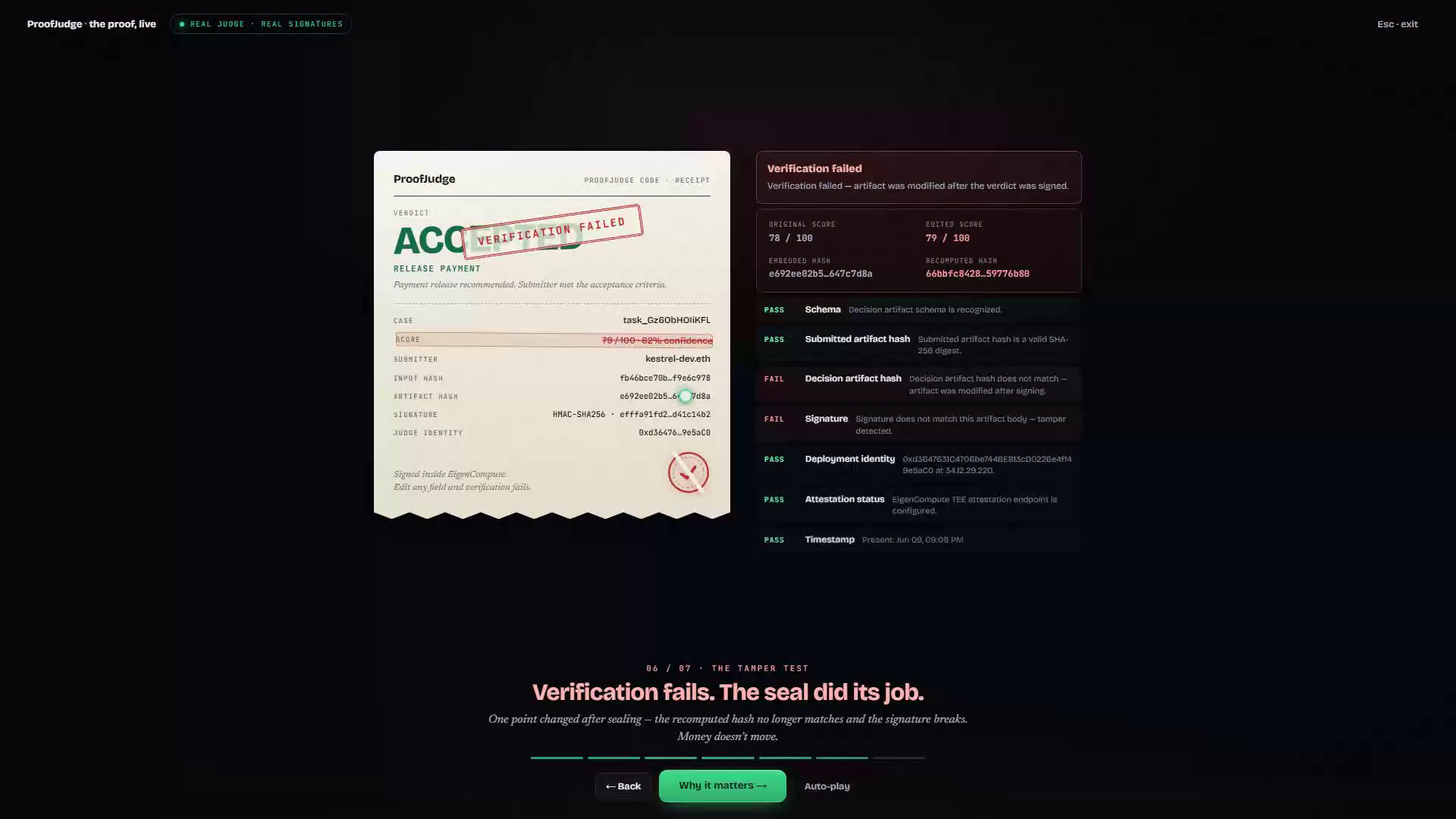
The project’s strongest demonstration is deliberately small: alter a signed receipt after the verdict. The artifact hash diverges, signature verification fails, and settlement should stop.
Release payment
The receipt body, hash, signature, identity fields, and timestamp agree with the sealed artifact.
The write-up
ProofJudge receives task terms, a rubric, and submitted work. The acceptance boundary becomes inspectable instead of remaining an unstated preference.
The resulting artifact carries the verdict, settlement recommendation, evidence checked, reasoning trace, hashes, signature, deployment identity, timestamp, and attestation mode.
The verification endpoint checks the schema, receipt body, artifact hash, service signature, identity fields, attestation mode, and timestamp. Altered fields break the seal.
Verification can establish which evaluator produced a decision under which rubric and whether the receipt changed. It cannot establish that the evaluator’s judgment was correct.
One receipt model
The same acceptance primitive was deployed for four kinds of consequential work, each with its own rubric and runtime identity.
Reviews code bounties and pull requests against explicit acceptance terms.
Evaluates sourced research deliverables and the evidence behind their claims.
Checks proposals against declared constraints from neutral ground.
Evaluates proposal completeness and risk before consequential votes.
What was built
The project includes a judging API, four domain configurations, signed receipt construction, a verification endpoint, deterministic fallback behavior, a guided proof sequence, and a browser receipt archive.
The larger question